Competitive market intelligence is the ongoing, lawful work of tracking what competitors do and the market they sell in, then turning both into pricing, promotion, and launch decisions. It covers rival prices, promotions, launches, messages, and hiring, read against a team's own sales. Competitive marketing intelligence is the same practice aimed at marketing calls.
Sena is the Decision AI from Rwazi with access to real-world data. It reads a team's own sales next to competitor shelf prices and promotions and shows where a rival's move cost volume, with sources and a confidence level. Sena captures the shelf data through Rwazi's 5M+ consumer network across 190+ countries when a question needs it.
For a consumer goods or retail team, the moves that decide a week sit on the store shelf:
- Shelf price: What a rival charges, store by store.
- Promotion depth: How deep and how often a rival discounts.
- Facings and share of shelf: How much space a rival holds.
- New listings: Which rival products appear and in which stores.
- Out of stock: Where a rival runs empty, store by store.
Ask Sena a competitor question
Put one competitor question to Sena, such as how a rival's price cut could shift a category. The answer comes back with its sources and a confidence level.
Key takeaways
- Start with the decision: Each source earns its place through the pricing, promotion, or launch call it feeds.
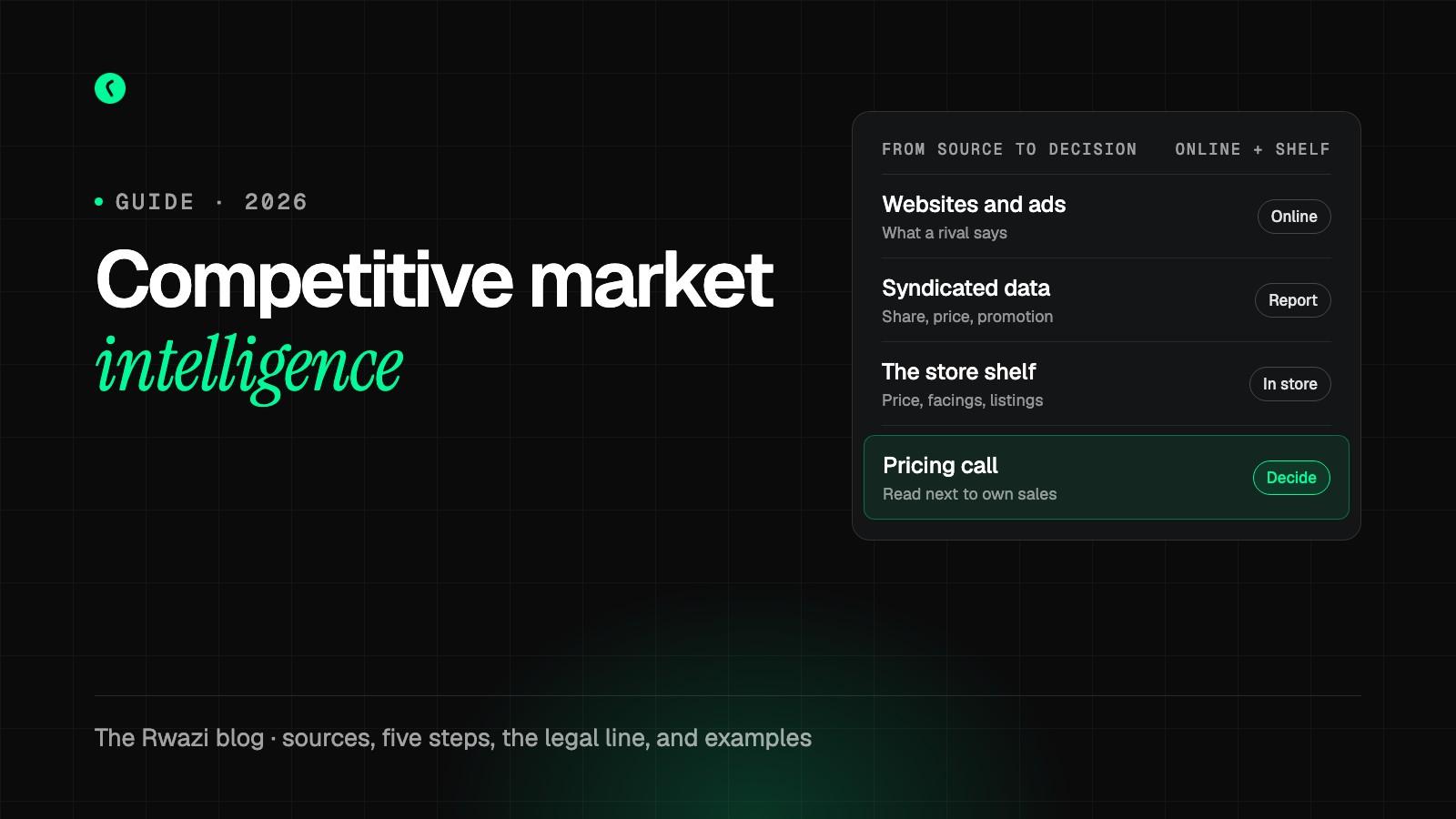
- Add the shelf: Websites and ads show what a competitor says. Shelf price, promotion depth, and listings show what it does in the store.
- Log every observation: A date, market, source, and confidence level make a signal usable.
- Measure by decisions changed: Count the calls the intelligence shifted, then track their results.
- Stay on the lawful side: Public sources and licensed data are lawful means. Obtaining a trade secret by theft or deception can be a federal crime in the US.
What is competitive market intelligence?
Competitive market intelligence combines two related terms:
- Competitive intelligence (CI): What specific rivals do, from products and prices to promotions, messages, hiring, and sales positioning.
- Market intelligence: The wider market, including size, demand, regulation, and consumer activity.
- Competitive market intelligence: Both, read together, so a team sees a rival's move and the market it lands in.
- Competitive marketing intelligence: The same practice, applied to marketing decisions.
Types of competitive intelligence
- Tactical: Near-term moves, such as a rival's price cut or a new promotion. These feed this week's pricing and promotion calls.
- Strategic: Long-term shifts, such as a rival entering a new category or country. These feed portfolio and launch plans.
- By subject: Product, pricing, promotion, message, sales, and hiring intelligence.
Sources of competitive intelligence
Every source shows part of a competitor's plan. The table lists the main source classes, what each shows, and its limit for a consumer goods team.
| Source | What it shows | Limit for a consumer goods team |
|---|---|---|
| Competitor and retailer websites | Positioning, product range, online prices, and offers | Online prices often differ from shelf prices |
| Retailer flyers and weekly ads | Featured prices, promotion depth, promotion timing | Shows the planned promotion, minus shelf compliance |
| Ads and social posts | Messages, claims, campaigns, launch timing | Shows the message, minus the in-store result |
| Press releases, annual reports, and filings | Strategy, investment, results by segment | Arrives after the move, and private rivals publish little |
| Job listings | New capabilities, new categories, new markets | An early hint that needs a second source |
| Patent and trademark filings | Product and pack ideas in development | Long lead time, and many filings stay unlaunched |
| Reviews and ratings | Product strengths and complaints | Covers buyers who post online, skewed to strong opinions |
| Sales team and win-loss notes | Why buyers chose a rival | Anecdotal, and hard to compare across markets |
| Trade publications and industry reports | Category trends, retailer news | Category level, on the publisher's schedule |
| Syndicated retail data (NielsenIQ, Circana) | Sales, share, price, and promotion by retailer | Covers the stores in the data set, reported after the period closes |
| Household panel data | Which households switched to a rival, and from which product | Covers a set of households, reported after the period closes |
| The store shelf | Shelf price, promotion depth, facings, share of shelf, new listings, out of stock | Needs capture in each store and market |
Competitive intelligence platforms such as Klue and Crayon serve sales and product marketing teams. They track competitor websites, pricing pages, and news, and turn win-loss notes and sales calls into battlecards. Consumer goods teams add syndicated data and competitive shelf intelligence to see the share of shelf, store by store.
Start with the team's own sales
Sign up for Sena with 50 credits, upload a sales file, and ask which packs lost volume, where and when. That list shows which rival moves to check first, ahead of the next price review.
How competitive intelligence feeds pricing and promotion
- Price response: A rival cuts price on a core pack. The team decides to match, hold, or answer with a promotion based on where its own volume moves.
- Price gap targets: The gap between the team's own price and each rival, private label included, read against how far volume moves as the gap widens. That reading sets the gap to defend.
- Promotion planning: Rival promotion depth and frequency set the bar a team's own promotions compete against.
- Launch timing: Rival new listings show where a category is filling up and where space remains. The competitive product analysis page covers the launch side.
- Shelf space: Facings and share of shelf show which retailers favor a rival ahead of the next range review.
- Messaging: Rival pack claims and ads show which benefit a category is fighting over. Competitor monitoring tracks rival moves on price, pack, placement, and claims, market by market.
- Sales positioning: Rival prices and claims feed battlecards for account teams. The competitive intelligence for sales page covers the sales side.
How to gather competitive intelligence
The five steps of competitive intelligence run from the decision to the result.
- Start with the decision. Name the call the intelligence feeds, such as next quarter's promotion plan or a price review on one pack.
- Map the competitors. List direct rivals, private label, and substitutes that answer the same need.
- Match sources to the decision. Price calls need shelf prices and promotion depth. Message calls need ads and pack claims.
- Collect on a set rhythm, and log each observation. Record the date, market, store or channel, source and confidence level for every signal.
- Turn signals into a decision with an owner. Assign the call, set the expected result, and check the result after the change.
The guide on how to gather market intelligence covers the wider market side of the same process.
Frameworks that structure the analysis
Teams structure competitive intelligence with a few standard frameworks. SWOT sets a team's strengths and weaknesses against each rival. Porter's Five Forces maps rivalry, buyer and supplier power, substitutes, and new entrants. Win-loss reviews show why buyers chose a rival. For consumer goods teams, a price index by store and pack turns shelf data into a pricing call.
Is competitive intelligence legal and ethical?
Competitive intelligence is legal when it uses lawful means. In the US, the line sits in federal trade secret law:
- Lawful means: Public websites, filings, ads, published reports, licensed data, a team's own customer conversations, and prices on display in stores open to the public.
- Lawful by statute: Federal law names reverse engineering and independent derivation as lawful means, in Title 18, Section 1839(6)(B) of the US Code.
- Improper means: Federal law lists "theft, bribery, misrepresentation, breach or inducement of a breach of a duty to maintain secrecy, or espionage through electronic or other means" (Section 1839(6)(A)).
- Criminal risk: The Economic Espionage Act of 1996 makes theft of trade secrets a federal crime (18 U.S.C. 1832).
- Civil risk: The Defend Trade Secrets Act of 2016 lets a trade secret owner sue in federal court (18 U.S.C. 1836).
- The ethical line: Analysts state who they are and who they work for in every interview. Confidential documents from a rival's former staff stay unread, since using a trade secret from someone who owed a duty of secrecy counts as misappropriation under federal law (18 U.S.C. 1839(5)).
This section summarizes US federal law as general information. Most US states add their own trade secret laws based on the Uniform Trade Secrets Act, and the EU sets a shared baseline in its 2016 Trade Secrets Directive. Each company's legal team sets the policy for its markets.
How to measure competitive intelligence
Competitive intelligence earns its budget through the decisions it changes and the results of those decisions:
- Decisions changed: The number of pricing, promotion, and launch calls each quarter that shifted because of competitive intelligence.
- Response time: The days between a competitor's move and the team's response.
- Price index: The team's shelf price against each rival, by store and pack.
- Promotion return: The volume and margin from a counter-promotion against the plan.
- Early warning rate: The share of rival launches and price moves the team spotted before they showed up in sales.
- Forecast accuracy: How close volume forecasts land once rival moves are in the model.
Competitive intelligence examples
- Rival out of stock: A rival's core pack runs empty across one retailer's stores for three weeks. The team raises shipments to that retailer and books extra display space while the rival's buyers pick a substitute.
- Private label listing: A retailer adds a private label version of a top seller. The team checks the price gap and facings, then plans a pack-size response.
- Promotion depth: A rival moves from shallow monthly discounts to deep quarterly ones. The team moves its own promotion calendar away from the rival's deep weeks.
- Hiring signal: A rival posts roles for a new category. The team checks trademark filings and early listings before planning its own entry.
- Message shift: Rival ads move from price to health claims. The team tests its own health message before the next range review.
The pricing intelligence and MAP enforcement use case shows the price-gap example in depth.
Competitive intelligence setup by channel and budget
| Situation | Lead sources | Typical setup |
|---|---|---|
| Deal-led B2B sales | Websites, pricing pages, news, win-loss notes | A competitive intelligence platform such as Klue or Crayon, with battlecards for sales teams |
| Online-led sales (ecommerce, direct to consumer) | Retailer and marketplace listings, online prices, ratings, and reviews | Online price tracking, read next to own sales |
| Store-led sales, promotion-heavy category | Shelf price, promotion depth, syndicated data | Syndicated data plus shelf capture, read next to own sales |
| Store-led sales, launch-heavy category | New listings, facings, trademark filings | Shelf capture plus filing alerts |
| Small budget | Websites, ads, sales team notes | A shared log and a monthly review |
| Many markets | Shelf data in each market, syndicated data where it exists | Shelf data captured on request, read next to own sales |
The best market intelligence platforms guide compares the platforms behind each setup.
Where Sena fits: a rival's price cut
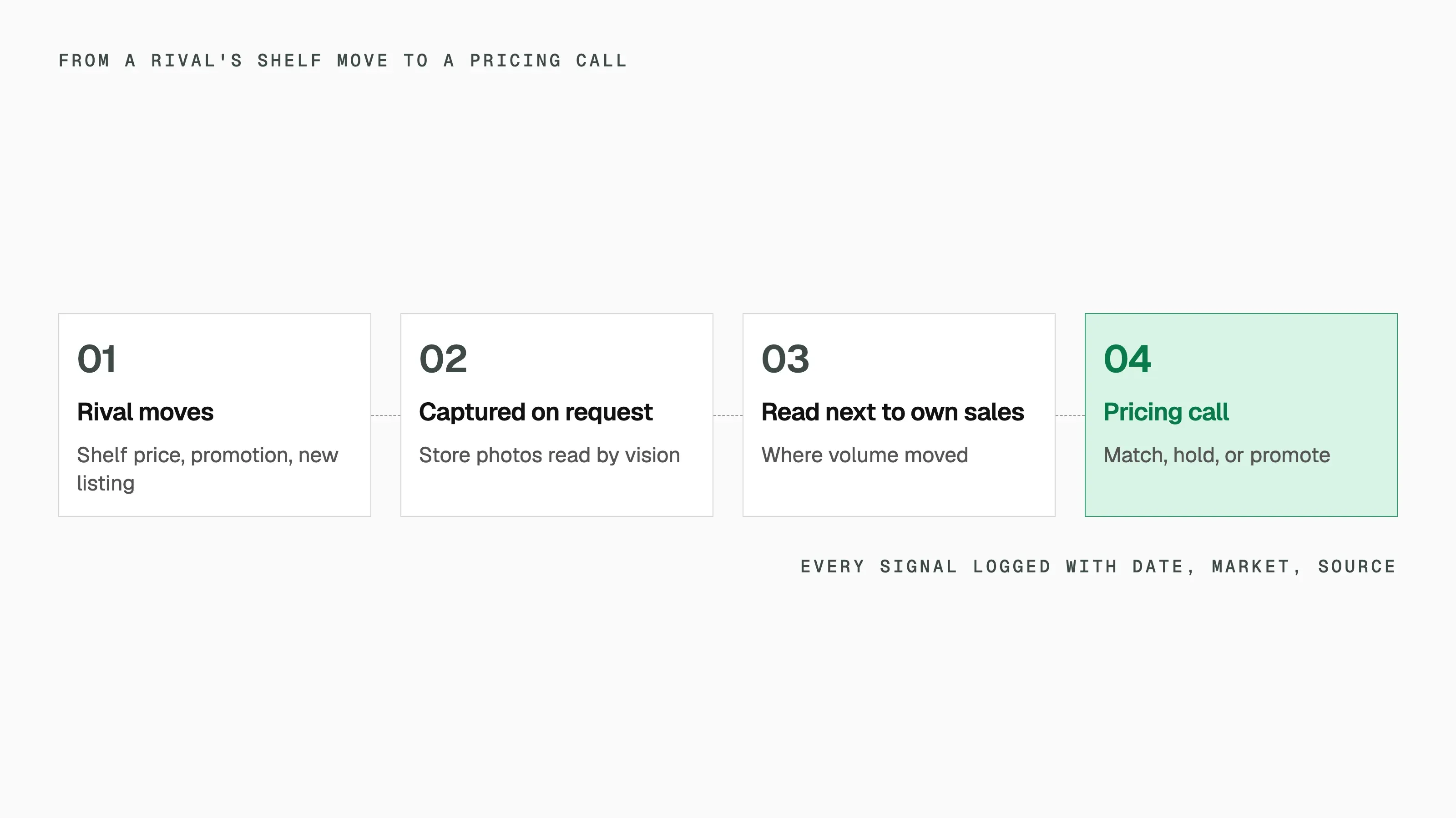
- The decision: A beverage team sees a volume dip on its core 500 ml pack in two markets, and the quarterly price review is due.
- What the syndicated report shows: Share, average price, and promotion by retailer for the last closed period. The price review also needs the shelf tag this month, store by store, and the stores outside the data set.
- What Sena reads: The team's sales files and syndicated data, plus store photos that contributors in Rwazi's 5M+ consumer network share when the question needs them. Sena's computer vision reads each rival's shelf price, promotion, facings, and new listings from those photos.
- Consent: Contributors in the network choose to share each store photo, and every photo comes from a store open to the public.
- What Sena returns: Which retailers and stores carry the rival's lower price, the price gap per pack, and whether the team's volume fell where the gap opened, with sources and a confidence level on the answer.
The team funds a promotion with the retailers where the gap cost volume and holds list price everywhere else, keeping margin on the rest of the pack's volume. The competitive pricing page covers the full pricing workflow.
Test a competitor question in Sena
Ask Sena a competitor question in chat, or sign up with 50 credits and upload the team's sales file.
Ask Sena a competitor question · Sign up with 50 credits
Frequently asked questions
What is competitive market intelligence?
Competitive market intelligence is the ongoing, lawful work of tracking what competitors do and the market they sell in, then turning both into pricing, promotion, and launch decisions. It covers rival prices, promotions, launches, messages, and hiring, read against a team's own sales and wider market demand.
What is competitive marketing intelligence?
Competitive marketing intelligence is competitive intelligence applied to marketing decisions. It tracks rival positioning, prices, promotions, ads, pack claims, and launches, then feeds a team's own pricing, promotion, message, and launch calls. For consumer goods teams, the store shelf is the source that shows the moves that decide a week.
What are the sources of competitive intelligence?
The main sources are competitor and retailer websites, ads and social posts, retailer flyers, press releases and filings, job listings, patent and trademark filings, reviews, sales team notes, trade publications, household panel data, syndicated retail data, and the store shelf. Consumer goods teams lean on the last two for prices, promotions, and listings.
How is competitive intelligence gathered?
Teams gather competitive intelligence in five steps: start with the decision, map the competitors, match sources to the decision, collect on a set rhythm while logging each observation with its date, market, source, and confidence level, then turn signals into a decision with an owner, and check the result.
Is competitive intelligence legal?
Competitive intelligence is legal when it uses lawful means such as public websites, filings, published reports, licensed data, and prices on display in stores open to the public. US federal law lists theft, bribery, misrepresentation, and espionage as improper means, and the Economic Espionage Act makes theft of trade secrets a federal crime.
What is an example of competitive intelligence?
A snack maker sees a rival's core pack drop in price across one region's stores. The team compares the price gap with its own sales, holds the list price where its volume holds, and funds a promotion with retailers where volume falls. That is competitive intelligence turned into a pricing decision.
How is competitive intelligence measured?
Competitive intelligence is measured by the decisions it changes and their results: the number of pricing, promotion and launch calls it shifted, the time from a competitor's move to the team's response, the price index against each rival, promotion return, the early warning rate on rival launches, and forecast accuracy.
What is the difference between competitive intelligence and market intelligence?
Competitive intelligence tracks what specific rivals do: products, prices, promotions, messages, and hiring. Market intelligence covers the wider market: size, demand, regulation, and consumer activity. Competitive market intelligence reads both together, so a team sees a rival's move and the market it lands in.
What are the benefits and risks of competitive intelligence?
Competitive intelligence brings three main benefits: faster responses to rival price and promotion moves, fewer surprises from rival launches, and sharper positioning against each rival. The main risks are data overload, conclusions drawn from a single source, and collection methods that cross the legal line. A decision-first setup and a second source on every signal keep both risks in check.
What are competitive intelligence platforms?
Competitive intelligence platforms collect and organize competitor information. Platforms such as Klue and Crayon track competitor websites, pricing pages and news, and feed battlecards and win-loss analysis for sales teams. Consumer goods teams add syndicated retail data from NielsenIQ or Circana, plus shelf capture for in-store prices, promotions, and listings, read next to their own sales.
Ask Sena a competitor question · Sign up with 50 credits
Read next: How to gather market intelligence and What is syndicated data?