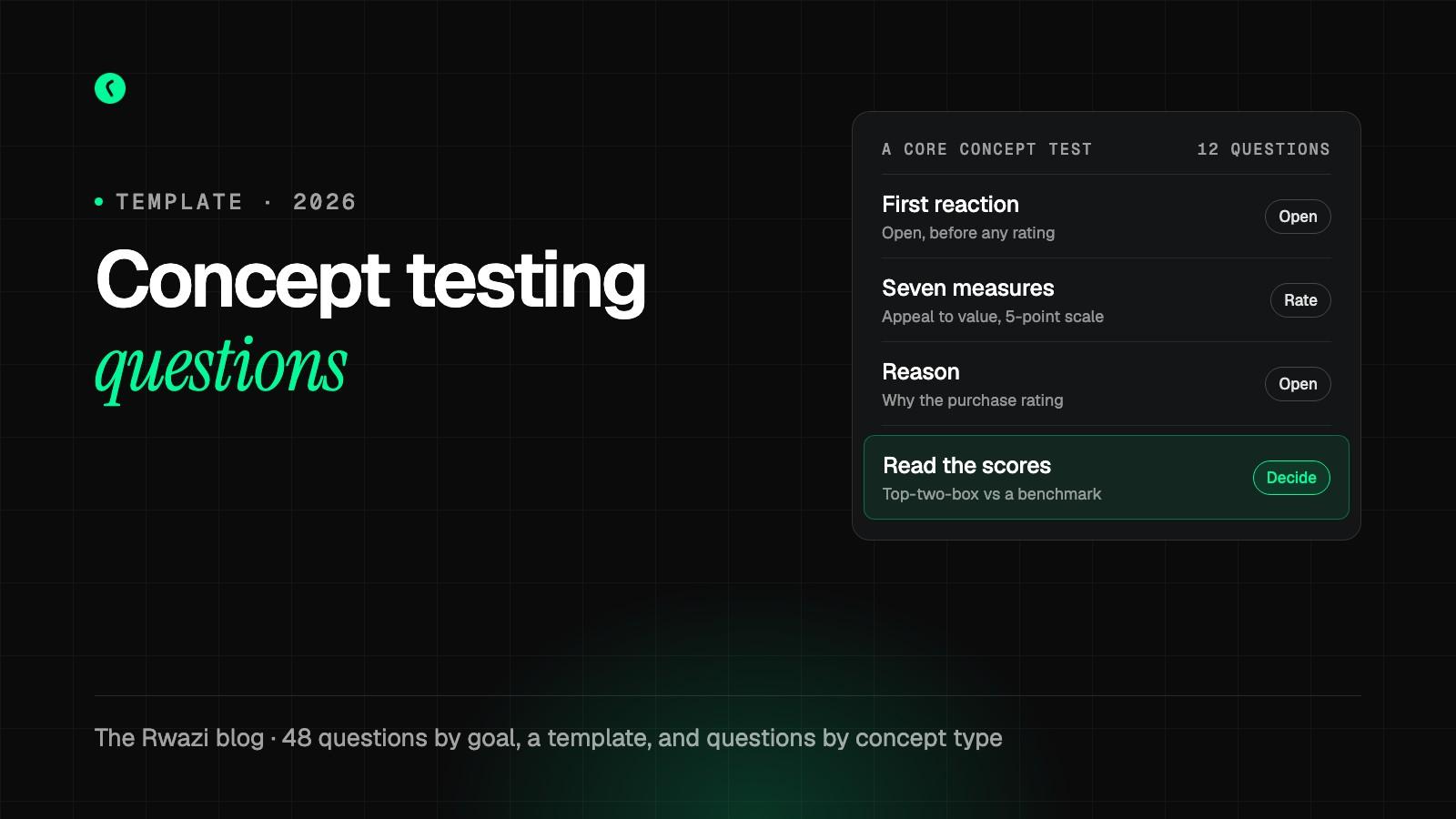
Concept testing questions measure how people react to a new idea before launch. A strong concept test opens with the first reaction in the participant's own words, rates seven measures on a five-point scale, then asks about the reason behind the scores:
- Appeal: How much people like the idea.
- Clarity: Whether they understand what it does.
- Uniqueness: How different it feels from what they buy today.
- Relevance: Whether it fits a need they have.
- Believability: Whether the promise feels credible.
- Purchase intent: How likely they are to buy it.
- Value: Whether the price feels right.
This guide lists 48 questions grouped by goal, a 12-question template, and the questions to lead with for each type of concept. Sena is the Decision AI from Rwazi with access to real-world data. It reads concept test results next to consumer activity in the target market and shows where purchase intent and price hold up, with sources and a confidence level. Sena captures that consumer activity when a question needs it.
Put one launch question to Sena, such as which of two markets shows stronger purchase intent. The answer comes back with its sources and a confidence level.
Key takeaways
- Open reaction first: Ask for the first reaction before any rating, so the answer comes in the participant's own words before a scale shapes it.
- The same seven measures every time: A fixed question set lets teams compare one concept against the last.
- A "why" for every key score: The open answer explains the number and points to the fix.
- Scores read against a benchmark: Compare each score with a past winner or a control concept tested the same way.
Concept testing questions by goal
Rated questions use a five-point agreement scale (strongly agree to strongly disagree) unless the format says otherwise. Replace [category] with the product category being tested.
Screening questions
- "I bought [category] in the past three months." (True / False)
- "I choose which [category] products my household buys." (True / False)
- "Most recent [category] product bought:" (list of current products, plus Other)
Need and current use
- "How often does the problem this product solves come up?" (Daily / Weekly / Monthly / Less often / Rarely)
- "This problem matters to me today."
- "How is this problem handled today?" (open)
- "Which products are used for this need today?" (list of products, plus Other)
- "I am happy with the products I use for this today."
First reaction
- "What is the first reaction to this idea?" (open)
- "Which three words describe this idea?" (open, or pick up to three from a list)
Appeal
- "Overall, I like this idea."
- "What stands out most about this idea?" (open)
- "What is the least appealing part of this idea?" (open)
Comprehension and clarity
- "Describe in one sentence what this product does." (open)
- "I understand what this product does."
- "The description is easy to follow."
- "Who is this product designed for?" (open)
- "What, if anything, is unclear about this idea?" (open)
Relevance and fit
- "This product fits my needs."
- "This product fits into my daily routine."
- "When would this product get used?" (list of occasions)
- "How often would this product get used?" (Daily / Weekly / Monthly / Rarely)
Uniqueness and switching
- "This product is different from what I buy today."
- "This product solves a problem other products leave open."
- "Which current product is closest to this idea?" (open)
- "This product would replace something I use today." (True / False, then which product)
- "How likely is a switch from the current product to this one?" (Very likely / Likely / Unsure / Unlikely / Very unlikely)
Believability and concerns
- "I believe this product would deliver what it promises."
- "The claims about this product feel credible."
- "What would make this claim easier to believe?" (open)
- "What concerns come up about trying this product?" (open, or pick from a list)
- "What would need to be true before buying this product?" (open)
Purchase intent
- "How likely is a purchase of this product in the next three months?" (Very likely / Likely / Unsure / Unlikely / Very unlikely)
- "If this product were on the shelf today, it would go in my basket." (Yes / Maybe / Unlikely)
- "How soon would a first purchase happen?" (Right away / Within a month / Within six months / Later)
- "I would recommend this product to a friend."
- "Rank these concepts from most to least likely to buy." (ranking, for comparative tests)
Price and value
- "This product is worth the price shown."
- "At what price would this product feel too expensive to consider?" (open number)
- "At what price would this product feel so cheap that its quality is in doubt?" (open number)
- "At what price would this product start to feel expensive, though still worth considering?" (open number)
- "At what price would this product feel like a bargain?" (open number)
Questions 39 to 42 are the Van Westendorp price sensitivity questions. Together they show the price range a concept can carry.
Features and improvement
- "Which feature matters most?" (pick one from a list)
- "Which feature matters least?" (pick one from a list)
- "What one change would make this idea more appealing?" (open)
Ad and message tests
- "The main message of this ad is clear."
- "Which company is this ad for?" (list of companies, plus Other)
- "This message makes the product more appealing."
Concept testing survey template
A core concept test fits in 12 questions, with the open first reaction ahead of every rating. Copy or print this template, then add questions from the list above as the decision needs them.
| Order | Measure | Question | Format |
|---|---|---|---|
| 1 | Screening | I bought [category] in the past three months. | True / False |
| 2 | Concept | Show the concept: name, one-line description, image, price | Exposure |
| 3 | First reaction | What is the first reaction to this idea? | Open |
| 4 | Appeal | Overall, I like this idea. | 5-point agreement |
| 5 | Clarity | I understand what this product does. | 5-point agreement |
| 6 | Uniqueness | This product is different from what I buy today. | 5-point agreement |
| 7 | Relevance | This product fits my needs. | 5-point agreement |
| 8 | Believability | I believe this product would deliver what it promises. | 5-point agreement |
| 9 | Purchase intent | How likely is a purchase of this product in the next three months? | Very likely to very unlikely |
| 10 | Value | This product is worth the price shown. | 5-point agreement |
| 11 | Reason | What is the main reason for the purchase rating? | Open |
| 12 | Improvement | What one change would make this idea more appealing? | Open |
Run the launch call on the results
Sign up for Sena with 50 credits, upload the concept test export, and ask which concept and which market to launch first.
Concept testing questions by concept type
The core template stays the same. The questions to add depend on what the concept is.
- Food or drink product: Add occasions (21), frequency (22) and price (38 to 42), plus "This flavor fits the occasions I buy [category] for."
- Packaging: Add clarity (15 to 18) and uniqueness (23), plus "This pack stands out on the shelf." and "The pack makes the product easy to find."
- Price change: Run the Van Westendorp questions (39 to 42) and switching (27), plus "At the new price, this product is still worth buying."
- Ad or message: Add the ad questions (46 to 48) and believability (28 to 30), plus "This ad makes me more likely to buy."
- App or digital feature: Lead with comprehension (14, 18) and fit (20), plus "This feature makes the task easier."
- Service or B2B offer: Lead with need and current use (4 to 8) and concerns (31, 32), plus "This service would replace a process my team runs today."
How to write concept testing questions
- Open reaction before ratings: The first reaction comes in the participant's own words, before a scale suggests one.
- One idea per question: "clear and appealing" in one line hides which one scored.
- One scale throughout: The same five-point scale makes measures comparable.
- Neutral wording: "How likely is a purchase" reads neutral. "How excited are people about this" leads the answer.
- Concept before questions: Every participant sees the same description, image, and price first.
- Rotated order: When one person sees several concepts, rotate the order so every concept gets an equal start.
- Short core test: The 12-question template covers the decision. Extra questions belong in a follow-up.
Concept testing methods
- Monadic: Each participant sees one concept. The cleanest read, with the most participants needed.
- Sequential monadic: Each participant sees two or more concepts in rotated order. Fewer participants, with some order bias.
- Comparative: Concepts appear side by side, and participants pick or rank them. Fast for choosing a winner.
The best concept testing platforms guide compares the platforms that run each method.
How to read concept testing results
- Top-two-box score: The share of participants who pick the top two points of the scale, such as "very likely" plus "likely" to buy.
- Benchmarks: Compare each score with a past winning concept or a control concept tested the same way.
- Stated intent runs high: People say they will buy more often than they do, so many teams discount top-box purchase intent.
- Open answers: Group the first reactions and "why" answers by theme. The biggest theme behind low scores points to the fix.
- Price range: The Van Westendorp answers show where interest drops, which sets the price to test next.
Concept testing examples
- New snack flavor: A food company tests three flavors with sequential monadic questions on appeal, uniqueness, and purchase intent. The flavor with the highest top-two-box intent and the strongest "why" goes to a store test.
- App feature (UX concept testing): A product team shows a mockup of a new checkout step and asks comprehension and fit questions, plus "What, if anything, is unclear about this idea?" The open answers shape the next design round.
- Ad message: A marketing team tests two headlines for the same product with the ad and message questions, then runs the clearer one.
Where Sena fits: from concept score to launch call
- The decision: An innovation team has a new snack format with a strong concept score, and the launch call for two markets is due.
- What the concept test shows: Appeal and purchase intent from the people who saw the concept. The launch call also needs the market around them.
- What Sena reads: The team's concept test export and sales files, consumer activity that Sena captures through Rwazi's 5M+ consumer network when the question needs it, and store photos read by computer vision. Those show who sells in each market, at what price, and in what formats.
- What consumers share: In each market, consumers see the concept and share their preference, purchase intent, and willingness to pay.
- Consent: Every answer is zero-party data, shared directly by a consumer who chose to share it.
- What comes back: The willingness-to-pay range against store prices today, and which market shows stronger purchase intent, with sources and a confidence level on the answer.
The innovation team launches first in the market with the stronger purchase intent at a price inside the range where volume and margin both hold.
Test the launch question in Sena
Ask Sena a launch question in chat, or sign up with 50 credits and upload the concept test results.
Ask Sena a launch question · Sign up with 50 credits
Frequently asked questions
What are concept testing questions?
Concept testing questions measure how people react to a new product, feature, ad or message before launch. They open with the first reaction, rate appeal, clarity, uniqueness, relevance, believability, purchase intent and value on a five-point scale, and ask about the reason behind the scores.
What order should concept testing questions go in?
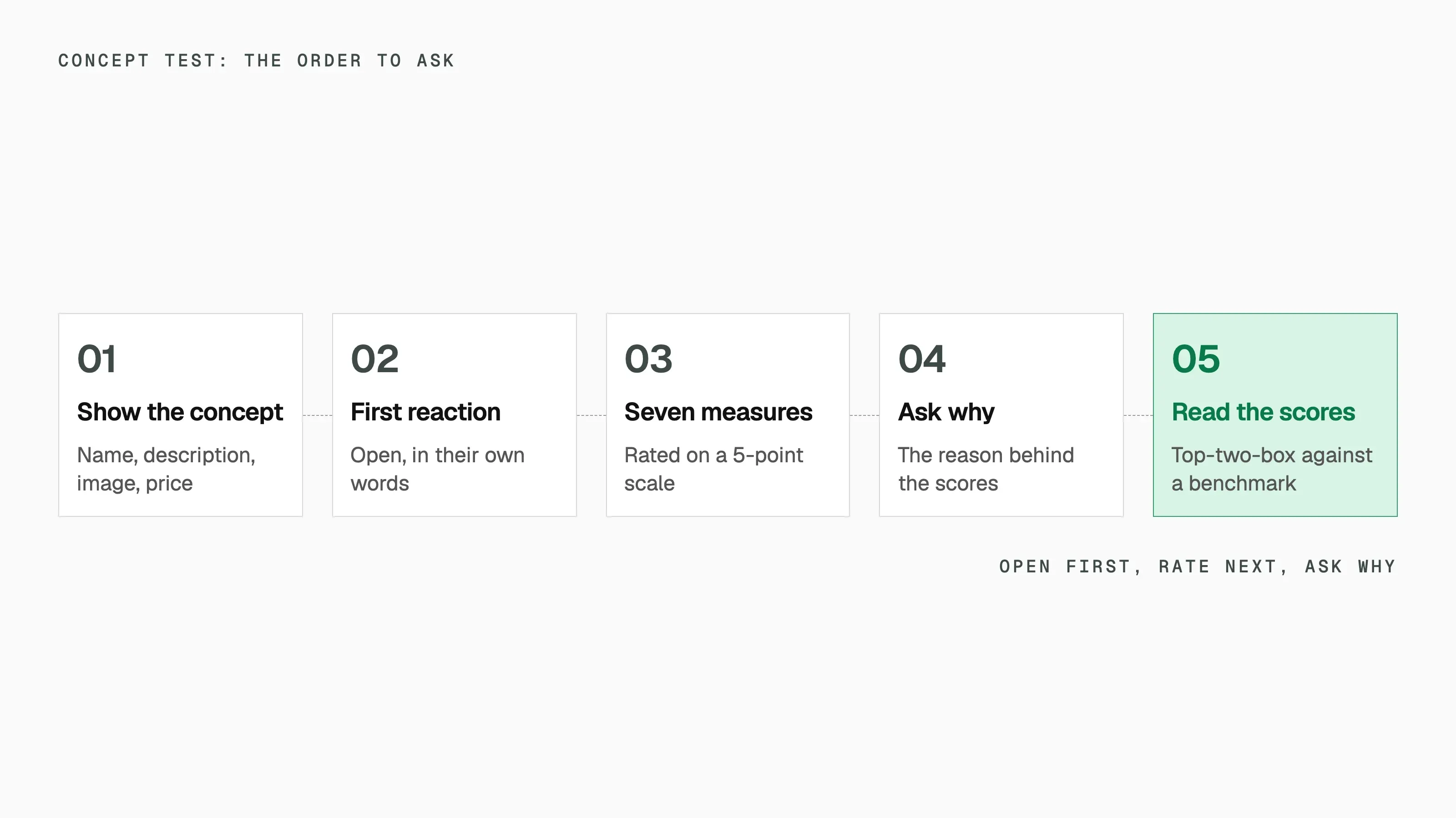
Screening comes first, then the concept itself, then an open question about the first reaction. Ratings for the seven measures follow, then an open question about the reason for the purchase rating, and an improvement question last.
How many questions should a concept test have?
A core concept test fits in about 12 questions: one screening question, the concept itself, the open first reaction, one rating per measure, and two open questions. Need, price, concern and ad questions get added when the decision needs them.
What questions measure purchase intent?
The standard question asks how likely a purchase is within a set time, such as the next three months, on a scale from very likely to very unlikely. Teams often add timing, a basket question and a recommendation question, then read the top-two-box share.
What is a top-two-box score?
A top-two-box score is the share of participants who choose the top two points of a scale, such as "very likely" and "likely" to buy. Teams compare it against a benchmark concept tested the same way.
What are the Van Westendorp price questions?
The Van Westendorp method asks four price questions: the price that feels too expensive, the price so cheap that quality is in doubt, the price that starts to feel expensive, and the price that feels like a bargain. Together they show the price range a concept can carry.
What is a concept testing survey?
A concept testing survey shows people a new idea, then asks a fixed set of questions about it. It measures appeal, clarity, uniqueness, relevance, believability, purchase intent and value before a team commits to building or launching.
What are good concept testing questions for UX?
UX concept tests focus on comprehension and fit: whether people can describe the feature in their own words, whether it fits a task they have, and what is unclear. Open questions such as "What, if anything, is unclear about this idea?" carry most of the value at the mockup stage.
What is an example of concept testing?
A food company shows three new snack flavors to category buyers and asks appeal, uniqueness and purchase intent questions for each. The flavor with the highest top-two-box purchase intent and the clearest reasons moves on to a store test.
What is the difference between monadic and sequential monadic testing?
In a monadic test, each participant sees one concept. In a sequential monadic test, each participant sees two or more concepts in rotated order. Monadic gives the cleanest read, and sequential monadic needs fewer participants.
Ask Sena a launch question · Sign up with 50 credits
Read next: Best concept testing platforms and Synthetic respondents vs real consumers